
Language, Mushrooms & Cage: a mycopoetic view
—George Quasha
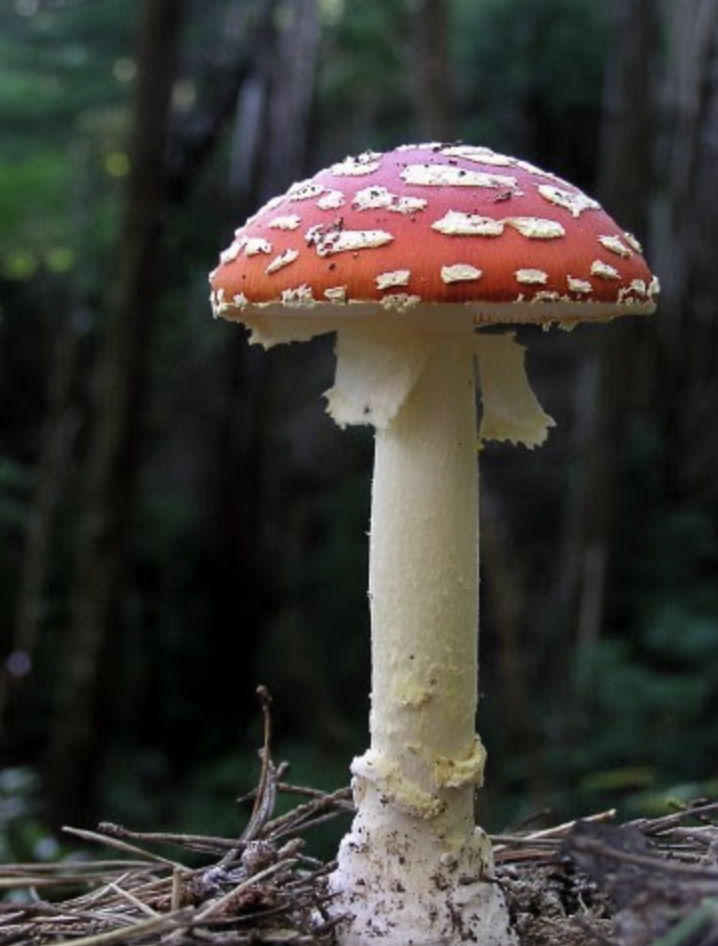
What is there still to learn from John Cage? Of course learning about Cage is also to learn from him in that his life was so much a realization of what his work explicitly embodied. For me personally it hardly exaggerates to say virtually every encounter over the 25 years I knew him was a teaching that has stuck. And so many of the memories live on in the language connected to the occasion. How just a few words can wake up the mind. We might think of that kind of arousing language event as in the nature of poetry.
Here’s an example: In the mid-1970s Cage gave a characteristically great performance of Empty Words at City University in NYC; it was the third time we heard him read entire two-&-a half hour sections, and we’d published Part I in our Active Anthology in 1974. For each performance he randomly projected images on a large screen continuously throughout—reproductions of Thoreau’s drawings from the Journals, which Cage enlarged from the tiny reproductions in the Dover facsimile edition of the complete published journals. The images became strangely powerful on that greatly enhanced scale, often fully suggestive of modern art, indeed some strikingly resembling abstract painting. Empty Words amplifies the method of its predecessor Mureau—the title a portmanteau of music and Thoreau—which reworks Thoreau’s comments on music and sound by subjecting them to systematic chance operations. It breaks them into sentence fragments, single words, and increasingly reduces them to syllables and letters. In Cage’s oral performance the rather abstract text becomes an entrancing language-music, and on this occasion it had a bewitching effect on me. In my personal listening trance I gradually became convinced that, on this occasion, Cage had diverged from his commitment to chance operations, because it seemed the images were so perfectly reflective of the text as it went along—almost like illustrations at times. How shocking it would be, I thought, that my hero might be cheating. So after the performance I went up to him and said, “John, that was beautiful, and how strange that the images went so perfectly with the particular words, almost as if pre-arranged.” He smiled and said, “Isn’t the good Lord marvelous?”
Such a spontaneous, direct and simple response was fully disarming of any possibility of what I’d made up. I got a too-close-for-comfort view of how when things happen we make up stories about them based on emotional response more than careful observation. Our stories might harden into new beliefs and take on a certain charge. If I hadn’t spoken with John, I might have had lingering doubts about his artistic integrity, which could have diminished the great gift that knowing, hearing and reading him had been. “Isn’t the good Lord marvelous!” But wait, I mused, how does a Zen Buddhist explain things by the Lord? Wait indeed, because right here is where we encounter poetry, and John Cage the poet of any given moment.
John Cage, poet: what does that really mean? In the book Silence and especially “Lecture on Nothing” he leaves no doubt about his connection to poetry, famously saying “I have nothing to say/and I am saying it/and that is poetry/ as I need it.” Indeed some speculate that it was his devoted reading of haiku that led to that particular 1949-50 work, as well as to his eventual connection to Zen when he encountered D.T. Suzuki. So if poetry is language at a higher intensity, Cage’s special poetic discovery was that straightforward speaking could reach the stepped-up poetic level in the tension between nothing and something, between nothing to say and saying something, between silence and sound. The poetry happens in the space between these apparent contraries, at the interface point or threshold or limen, as in liminal. Being at an edge in the distinction between contraries like nothing and something can function somewhere between being on edge and standing at the edge of the possible. And that’s related to what Cage calls indeterminacy. It’s an idea of art that embraces uncertainty to turn it into possibility.
Possibility seems to require that we give it the right space in which to be possible. “Lecture on Nothing” tells us pretty directly that it’s doing just that. He says: “This space of time/is organized/We need not fear these silences,--we may love them”. We discover that we’re in a special space of language talking about itself, and it happens in a way that serves as induction into the charged enclosure of its newly invented poetry. And the strange and arbitrary gaps between words and segments of sentences offer the kind of silence that gives us space, to feel something utterly unexpected. He assures us: “This is a composed talk/for I am making it/just as I make/a piece of music.”
When I was on the faculty of Stony Brook University in my mid-20s, I decided to teach a favorite text of mine, “Lecture on Nothing,” in my Experimental Poetry Course. I’d only read it silently, just approximating the rules, and imagined the effects of its self-interruptive rhythms. But in the lecture room that day I performed it following the rules more literally; and I could almost say that “in no time” I was in its grip—almost as if no time were it’s own kind of mind space. And in a mere ten or so minutes the impact had the feel of permanence; I can’t really say what it did for the listeners that day, but in me it created an awakening. Although I was the apparent agent, the performer, a veritable hypnotic induction took place and I was well inside its language-music trance. At a certain point I realized something new to me was happening. The text, for instance, mentions driving through Kansas, and by the second mention of Kansas it was as if I was in that car, traveling across the great Kansas emptiness. I experienced language as actual physical space which I was now passing through—a quietly startling immediacy—and the vehicle was language. I learned that a Cage work induces the trance it wishes to interrupt. I could have said, “Isn’t the good Lord marvelous!”
And I would be saying the words “good Lord” to mean an actual marvel, one that I was experiencing first-hand, and without the slightest commitment to any agency, let alone a theology. And that would be a property of poetic magic—to invoke the divine experience without reifying the divine. Cage the poet—“Lecture on Nothing” the poem—induced in me a previously unexperienced possibility of language as open space. Something like the sheer concreteness of timespace. Or the point where time and space are indistinguishable in the intensity of presence. And that would be a gap that exposes what I call linguality—language transforming what we know as real, because language invisibly co-creates our picture of reality in the first place, and thereafter it holds current reality projections in the ir place. And there we might reside, caught in our own construction, our linguality.
Cage’s spontaneous response to my statement after his performance was yet another instance of charged presence in speaking. And like those unanticipated empty spaces of the “Lecture on Nothing”, his remark has something to teach about poiesis. The Lecture-poem, with its silence inseparable from the sound of his voice, the “nothing” inseparable from speaking about it, is matched by an opposite intensity in his own natural words: sheer unguarded presence in speaking. Spoken words with the feel of embodied emptiness. A nothing that is the something that comes through a living person, a sentient speaker. One might call “Lecture on Nothing” a text with emptied sentience. It showed us that an alternative way of reading/listening induces an altered state of consciousness.
I considered calling this talk “The mushrooming of ideas in structured openness : Lecture on Nothing”. The obvious point is that ideas come to us the way fungi shoot up under favorable conditions; also it’s an obvious pun on Cage and mushrooms; and a play on Cage’s view of music as organized sound. And there’s another theme: what we say and how we say it has consequences, which would be a core rationale for language art itself.
I’ve wondered, for instance, if calling the atomic bomb blast a mushroom cloud had anything to do with one of the worst nightmares I had as a teenager: in my dream the atomic bomb had been set off at a neighbor’s house and I stared at the “mushroom cloud” in abject terror. Did the word’s dark usage become for me a frightening life event? I didn’t welcome mushroom images for a long while after. It’s likewise understandable, for instance, that aficionados of psychedelics avoid calling their nonaddictive substances drugs for reasons of harm avoidance. They change the name, referring to them as entheogens or medicines. Not just sticks and stones but words also break bones, create conflicts, set off religious wars. Think of our current president’s pervasive abuse of language—his war on words as well as with them, such as weaponizing the names of bodies of water and censoring terms like “climate change” in academic discourse. Words have powers, and some we hardly notice.
I’ve come to realize that a characteristic of writers who changed things for me was that they put a special spin on otherwise common words and ideas; the effect, instead of intimidating, is reanimating. Take the word “chance,” or in French “le hazard,” which has never been the same since Mallarmé’s A Throw of the Dice Will Never Abolish Chance; and another revolution in that word came about through Cage’s “chance operations” as a method for music and language. We don’t take that kind of chance, we harness it to go beyond its dangers and limitations.
Is there even such a thing as chance? Cage, of course, used the Chinese Book of Changes, the I Ching, in making choices in his music, writing and visual art. The I Ching embodies the view that everything is connected and what appears to be random is really part of a fabric that can be experienced as meaningful. It’s all in how we interpret and use it. In life we have to deal with what seem to be matters of chance occurrence, the unpredictable, the Newtonian physics level of randomized outcome; but all that’s a perspective that disappears both in the I Ching and in quantum physics and nonlinear dynamics. At other scales of awareness new patterns appear.
Things are entangled in more than one sense. And the one we’re focusing on here is language. On one level we appeal to reason to save us from the illusions and misuses of our language, and on another level we shape and refine those very illusions to awaken us to subtler meaning, to the utterly new possibility, the magical display of the marvelous, and the alternatives of consciousness. The core idea would be: a new world requires a new languaging—as a process of renewal in the very medium in which we construct a picture of reality.
Easier said than done. Cage found that the most important ideas had to be said again and again because thinking the new thoughts did not automatically mean living them. New ideas had to be integrated in the living process. But first they have to be integrated into speaking and thinking before they can make a difference. And just at the point where it seems some equilibrium is reached in living our ideas, something even more problematic turns up: the new ideas we want to say again turn out to not be the same the next time they occur: they mean something somewhat different each time we say or hear them. So Cage created a field of related ideas which he subjected to different randomizing methods that keep us from getting too comfortable with them; so that each time they happened they were different in a way that would prioritize thinking them again, or as Gertrude Stein put it, again and again and again, just as a rose is a rose. . . is a rose. Settled beliefs, however refined, can have the effect of blocking new ideas and experiences.
Who would have expected that the language that fits new thinking so well, and becomes a welcoming place for the mind to take refuge, could become a major obstacle to waking mind? The sad news is our favorites may not be sustainable. So Cage makes his work self-interfering, and we as listeners inherit his interference—and that’s one of the dangers of his kind of poetry. This points to why it’s important to take Cage’s thinking in his lectures, however attractive, not as philosophy, but as poetry—ideas held in a space that opens mind to what it’s ready to know further.
Take Cage’s almost surreal way of explaining his love of mushrooms. His expressed reasons include the alphabetic fact that music comes after mushroom in most dictionaries. Cage soft-pedals such instances of outright poetic magic, and that may say it’s another name for chance operations with language. He reveals that his book M got its title by an I Ching chance operation performed on the alphabet, and then goes on to tell us how “M” stands for everything important in his life: music, mushrooms, mesostics, Merce Cunningham, Marcel Duchamp, M.C. Richards, Marshall McLuhan, and many more. You could call this synchronicity or non-causal connectivity across space and time—or maybe chance magic. I’ve always enjoyed the paradox that whenever Cage used the chance method as a way of getting beyond ego and personal preference, there always remained his personal imprint, style, manner, and meaning. You know a Cage drawing when you see one. His lecture scores too. Indeed his vocal style of reading aloud. And let’s not fail to mention his personal presence. His casual speaking. His way of being.
This does not come down to a method or technique of better living the mask. One of Cage’s favorite poets was Jackson Mac Low, a former student along with Dick Higgins—indeed Mac Low supplies yet another “M” for the magic archive. Eventually Mac Low gave up the chance method as such, noticing that it failed to fully eliminate the ego and personal preference. I’m quite sure Cage knew this for himself, and I suspect his attachment to the method persisted as largely aesthetic—he loved its simple elegance, its optimizing energy, and for him it was a kind of life/work magic—it made new works spring up like mushrooms in a wilderness of poetry.
This brings us to focus on another approach to chance and related issues: let’s call it a walk in the woods. What draws us to the wild? Love of the fresh and uncorrupted, perhaps, and a pleasure in the uncertain, even the dangerous. Sometimes it’s a direct and intuitive connection to what thrives in the wild, like fungi. It can become a secret extreme sport of the mind as of the body and, as with silence-and-saying, their inseparability.
So I’m sensing one of the reasons Cage the composer of music loved both mushrooms and poetry is that they’re so alike. At least his idea of poetry. Beautiful flower gardens may correspond to a common view of how poetry serves life, but Cage’s conception, often called “experimental poetry,” corresponds far better with fungi. It’s partly a matter of predisposition to one kind or another. Valentina and R Gordon Wasson coined the helpful terms mycophilia and mycophobia in 1957. Mycophiles often feel a culinary pull, and great cuisines like French and Chinese feature fungi prominently, but mycophobes like Indians, as Cage points out, rarely use them in cooking and may view them as dirty. However, summer of ’74, when we taught at Naropa in Boulder at the same time as Cage, he gathered mushrooms around town and got the local Indian restaurant to cook them and invited several of us to a delicious dinner. It showed that mycophobia can transition to mycophilia. A mycophobe might have a great fear of fungal toxicity, or connect them with natural decay, rot, and death, or view the unpredictable way mushrooms just shoot up as threatening our control. And we could map these less desirable characteristics onto metrophobia, the curious term for a fear of poetry. Avoidance of both mushrooms and poetry may be considered irrational, yet they also make a certain sense, as both shake up the very idea of a normal in life.
A walk in the woods hunting mushrooms has high stakes—indeed Cage wryly cites the view that fungi experts tend to die of fungal toxicity. Our relationship with fungi is complex: we make things and they take things apart—we eat them; eventually they eat us. On this model, language builds pictures, and poetry—Cage’s kind—takes language and its pictures apart. So reading a lot of strange poetry takes a toll. It puts consensual reality on alert, and the ordinary mind along with it. In the lore of poetry, poets starve for their art, or a la Ginsberg’s Howl, along with the best minds of their generation, are “destroyed by madness, starving hysterical naked.” So let’s say: The fungal kind of danger’s directed at the body, the language kind at the mind. But wait, the contrary is also true, especially for psychotropic mushrooms. You don’t eat them before going to work.
Gordon Wasson’s famous/infamous account of Psilocybe mexicana and his sessions or veladas with the Mazatec curandera María Sabina, first reported in Life Magazine of May 13, 1957, served as the outing of psychedelics for the American public. Here you could truly say, mushrooms changed history. Many would call it a grave danger, others a revolution in consciousness. On another scale this long arising transformative event paralleled another one that was reordering minds: D. T. Suzuki’s 1950 presence in New York among the musicians, poets and artists. Cage and Mac Low saw these Zen teachings as pointing to a new way in art, a shift from self-expression to “non-intention,” an art medium that allowed the mind to freely discover itself in play, in short, to wake up to its intrinsic freedom of being.
Also in 1950 Christian Wolfe introduced Cage to the I Ching, and so systematic chance operations served to structure music, eventually to structure language for both Cage and Mac Low. The approach matched language and concept with quantum mechanics: Cage explicitly offered the concept of Indeterminacy and pervasively worked with composition as event and interconnected field of ambient sound, of silence and saying, of further mind activity and stillness. Synchronistically in 1950 Charles Olson published his poetry-transforming essay “Projective Verse” embracing “composition by field.” It’s all about how we are present in time. Which occurs in space. Music for Cage happens in “empty time” which instead of harmony, pitch, and syntax focuses on time duration. In “Lecture on Nothing” speaking is not progressive—it goes nowhere; it’s radial, and it surrounds you. Listening to “Empty Words” you walk in the language woods where words spring up all around and you can let go into its silences. These are gaps, a still point that holds potential to reset the human nervous system.
Poiesis and fungi can restructure language to reveal mind operating in a field of forces. Thinking here quickly shows a connection with mycelium, the tangling underbody of fungi that can extend for acres. A recent best-selling book by Merlin Sheldrake, Entangled Life, has brought wider attention to a development in biology that gained momentum in the second half of the 20th Century. If Cage were alive I think this would be a favorite. Sheldrake shows the individual mind—think ego or agent—is not simply the director in the field; rather it’s the reception point where a vast array of factors intersect, each moment a singularity, an unrepeatable event in consciousness. And today life is imitating art again as biology increasingly discovers principles first manifesting in new music and poetry and in quantum physics.
Mycelium is the primary language medium of the forest, the so-called wood-wide web, the conductor of wordless chemistry, which trees use to speak to each other. Even science mind now finds itself unable to deny the high intelligence at work in the living field and that the operating system has all the indications of consciousness. Plants and fungi talk to each other, strategize together, and there are people who report understanding them, notably non-speaking humans on the autism spectrum. Ayahuasca shamans say plants teach them medicine practice. María Sabina ate Psilocybe mexicana to hear a voice speaking her native tongue, which gave her cures for visiting patients. All of the above experience language as itself alive and aware.
Perforating the boundary between life and art, foregrounded by Marcel Duchamp, Fluxus and Cage, does not of course mean making art ordinary, but it does encourage life to reveal the extraordinary in every moment, Blake’s eternity in a grain of sand. An extension of this view is that life itself can be meaningfully viewed as radically self-transforming in the way of art, something consciously engaged for the sheer joy of optimizing its gifts. It’s a view of work/art/life that sees it, not as an achievement or accoutrement or earned prize or luxury, but as an essential dimension of being. Yet we ask: why do this when there’s so much trouble in the world? It’s beyond justification. As William Carlos Williams said of poetry, “Men die miserably everyday for want of what is found there.” And now you expect me to say, “Isn’t the Lord marvelous!” but I wouldn’t dare.
©2026 George Quasha